Cinnamon Akasaka
The Wind-Up Bird ChronicleCinnamon Akasaka is the silent son of Nutmeg Akasaka, introduced through the exacting polish of his clothes and a communication that depends on gestures rather than speech. His childhood episodes place that composed exterior beside a disorienting inner life: he dreams of digging up a buried bundle, then wakes convinced that his self has been put into a new body and finds he cannot call for his mother. The gap between his immaculate appearance and his unspoken experience makes him a figure of controlled surfaces and uncertain identity.
Identity and Introduction
When Toru Okada visits the office identified as Akasaka Fashion Design, Cinnamon opens the door. He is young, slim, and strikingly handsome, but Toru’s attention fixes especially on the care of his clothes: a nearly dazzling white shirt, a deep-green patterned tie tied in a faultless knot, dark-gray trousers, and brown tasseled loafers. Everything appears new, as if put on only minutes before. This studied neatness is not incidental decoration; it is the first and most visible expression of Cinnamon’s controlled public presence.
Cinnamon is somewhat shorter than Toru, and a slight smile rests on his lips. Toru imagines the smile as the response to an elegant, almost ceremonious joke, an impression that lends the young man a polished social poise. Yet Cinnamon does not speak or allow Toru to introduce himself. He signals that speech is unnecessary, ushers Toru inside, and closes the door in silence. Toru reads his narrowed eyes as though he were apologizing for being unable to talk because a nervous black panther were beside him, while recognizing that no such animal is actually there. The image captures the mixture of courtesy and strangeness that surrounds Cinnamon from their first meeting.
Mutism and Communication
Cinnamon has stopped using his voice altogether. Nutmeg explains that he had never been much of a talker, but at six he suddenly ceased speaking; the change was complete, not simply a matter of talking less. When Toru asks whether there was a reason, Nutmeg does not answer. The account establishes the age and abruptness of the loss while withholding its cause, leaving a central fact of Cinnamon’s life unexplained.
His silence does not prevent him from communicating. In the office, he uses small movements of his lips and fingers to tell Toru not to be afraid and to put on a pair of swimming goggles. Toru understands the message accurately, nods, and follows the instruction. Communication here is neither ordinary spoken dialogue nor mere guesswork: Cinnamon’s gestures convey specific directions, and Toru receives them without a verbal exchange. The scene makes his mutism a practical condition of their encounter while showing that it does not erase his ability to direct it.
The goggles are an ordinary rubber-and-plastic pair, much like those Toru uses in a ward swimming pool. Their unexpected appearance interrupts the room’s composed atmosphere, where there is no audible music and no picture or clock on the walls. Cinnamon presents them, asks Toru to wear them, and emphasizes by gesture that Toru must not remove or shift them himself; Cinnamon will do that. The exchange gives his silent authority a precise form: he controls the procedure, while Toru agrees to trust instructions he receives without hearing a voice.
The Night Episodes
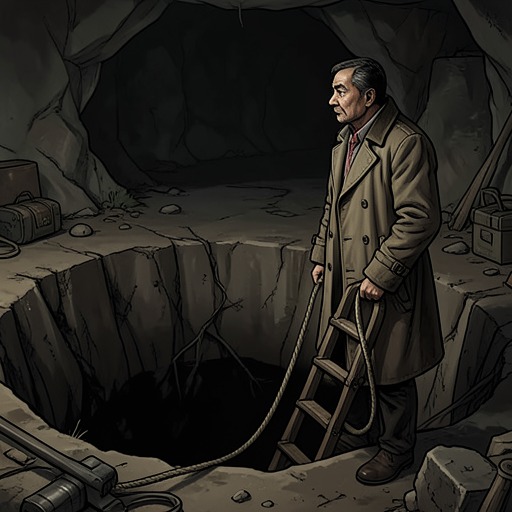
Cinnamon’s childhood is also narrated through an embedded account of the boy’s dreams and waking perceptions. After falling into a deep sleep, he has a vivid dream and takes comfort in knowing that it is a dream. He is convinced that the earlier events were real and that he can distinguish the two. That confidence is unsettled by what the dream contains: in the middle of the night, alone in the garden, he takes a shovel and digs through the hole a tall man has filled in, uncovering the cloth bundle the man buried.
The dream repeats the traces of an event that Cinnamon believes actually happened. The shovel has been left leaning against a tree; the soil has recently been filled in; and the bundle lies below. The boy digs despite the heavy shovel, his breathlessness, and his bare feet on the freezing ground. At the same time, the wind-up bird has stopped crying, and the man who climbed the tree—someone who looked like Cinnamon’s father—has disappeared. The quiet is so complete that it seems to hurt his ears. Cinnamon tries to separate the dream from the earlier occurrence, but the dream’s return to the real hole makes the distinction difficult to sustain: the scene turns his confidence about what happened into an explicit uncertainty about how reality can be recognized.
Waking and the Changed Self
In the morning, Cinnamon wakes alone in the middle of his bed. The familiar objects remain in place: desk, bureau, closet, floor lamp, and a wall clock showing six-twenty. Nothing obvious has been rearranged, yet he knows that the room is no longer quite the place in which he went to sleep. The air, light, sounds, and smells feel slightly different to him, although other people might not notice. The ordinary room becomes the setting for an alteration that cannot be verified by looking at its furnishings.
Cinnamon checks his body for visible change. His fingers move, his legs respond, and he feels neither pain nor itching. At the mirror, he finds nothing unusual in his face or in the reflection of his fair-skinned body. Still, he feels that his self has been put into a new container and that this body does not quite match his original self. The contrast between an apparently unchanged body and a changed sense of inhabiting it gives the episode its force: the disturbance is inward, but Cinnamon experiences it as a real break in continuity.
The break becomes audible through its absence. Overcome by helplessness, Cinnamon tries to call for his mother, but his vocal cords will not move the air. At first he feels that the word itself has vanished from the world; before long, he realizes that it is not the word that has disappeared. The episode places his inability to speak beside the dream’s uncertain boundary between the real hole and its dreamed excavation. Neither experience is explained away, and the account does not identify the precise cause of his mutism.
Narrative Significance
Cinnamon’s characterization repeatedly sets precise surfaces against what cannot be neatly read. His tie is perfectly knotted, his clothes seem brand-new, and his gestures communicate instructions with economy; yet the history of his silence remains unexplained, and his own account of waking life is troubled by a self that seems to occupy the wrong container. The polished appearance does not resolve the mystery of his inner experience. Instead, it sharpens the contrast between what can be seen and what cannot be said.
The night episodes also make Cinnamon’s experience a problem of perception rather than a simple report of unusual events. He distinguishes dream from reality by insisting that the buried bundle and the man’s climb into the tree truly happened, but the dream returns him to the very hole that anchors that conviction. On waking, the familiar room similarly appears unchanged while feeling altered. His story thus joins the novel’s concern with the unstable boundary between dream and waking life to the bodily fact of his silence, without supplying a definitive interpretation or cure.